
Core Topics & Detailed Analysis
Detailed breakdown and expert insights engineered across all core topics of this article.
Cross-Platform Foundation vs. Native Development Paradigms
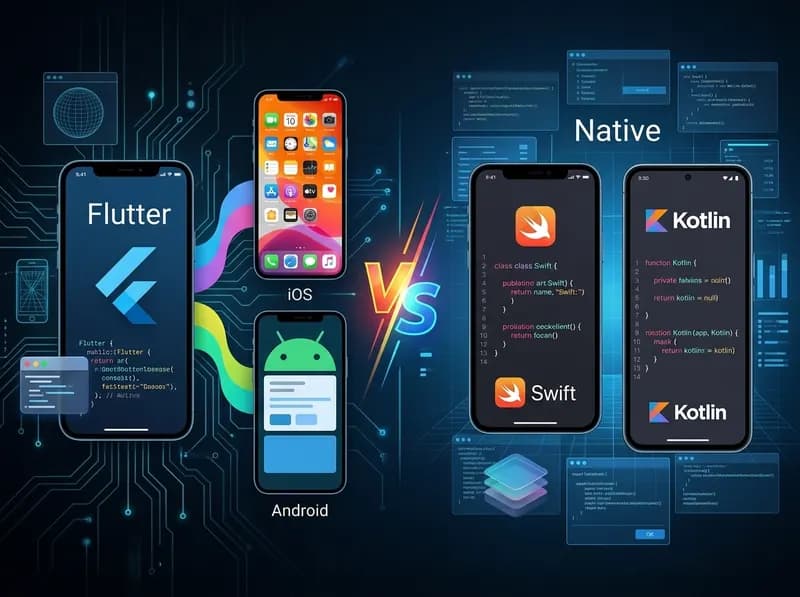
Native engineering necessitates maintaining isolated codebases in Swift and Kotlin, which yields peak device utilization but doubles development and QA overhead. Conversely, Google Flutter compiles high-performance machine code for iOS and Android from a single Dart repository, cutting deployment timelines in half.
Accelerated Time-to-Market and Rapid MVP Iteration
Agility is the defining metric of startup survivability. Leveraging Flutter empowers brands to launch fully verified MVPs across both app stores simultaneously, pushing layout enhancements and mission-critical patches in real time via stateful hot reload.
Bespoke UI Renders and Frame-Rate Consistency
Because Flutter bypasses OEM native widgets to render directly via proprietary engines, typography, micro-interactions, and visual themes appear pixel-perfect across all screen densities without OS-dependent UI deviations.
Mission-Critical Scenarios Requiring Native Architecture
Pure native development remains mandatory for compute-heavy graphics applications, augmented reality tools, low-latency audio mastering suites, or platforms requiring unabstracted, background-persistent hardware telemetry.
Long-Term Maintenance Savings and Team Scalability
The lifecycle cost of an app far exceeds its initial build budget. Operating a unified codebase reduces ongoing regression testing, OS version migrations, and security patch overheads by over 40% throughout the product lifetime.